How to Build a Brand Identity That Makes Your Business Memorable in 2026
Here is the short version: a brand identity is a system, not a single design. You build it by deciding what you stand for, then expressing that decision consistently across a logo, colours, typography, imagery, and voice. Skip the strategy and you get a nice-looking logo that still feels generic. If you are unsure how a logo differs from the wider system, start with logo design vs. brand identity, and if the brand behind the logo needs defining first, see what is brand strategy and what is brand positioning.
Below is the 6-step process we use on brand identity projects, refined across 3,000+ projects as a Top Rated Plus agency on Upwork. The order matters as much as the steps themselves, each stage constrains the ones that follow, which is exactly what stops the process from turning into an unstructured pile of design opinions.
The 6-step brand identity process
1. Strategy and positioning
Before any design, get clear on three things: who you serve, what makes you different, and the one feeling you want to own. Write a short positioning statement and three brand attributes (for example: confident, practical, modern). Every later decision is judged against these. This is the step most businesses skip, and it is why their branding never quite lands.
2. Moodboard and direction
Translate the strategy into a visual direction before committing to a logo. Collect references, define a rough colour mood, and agree on an overall feel with stakeholders. Aligning here saves expensive U-turns later, when opinions are harder to unwind.
3. Logo suite
Design the logo to fit the strategy, then build it out into a usable suite: a primary version, a secondary or stacked version, and a compact icon for favicons and app tiles. Test every version in one colour and at small sizes. A logo that only works big and in full colour is not finished.
4. Colour and typography systems
Define a primary and secondary palette with exact hex, RGB, and CMYK values, plus accessible text and background pairings. Choose a heading and a body typeface and set a clear hierarchy. Systems, not one-off choices, are what keep a brand consistent across a website, deck, and ad.
5. Imagery, voice, and components
Decide how your brand looks beyond the logo: photography style, illustration or icon style, patterns, and reusable components like buttons and cards. Define voice too, how you sound and the phrases you use, so your writing is as recognisable as your visuals.
6. Brand guidelines
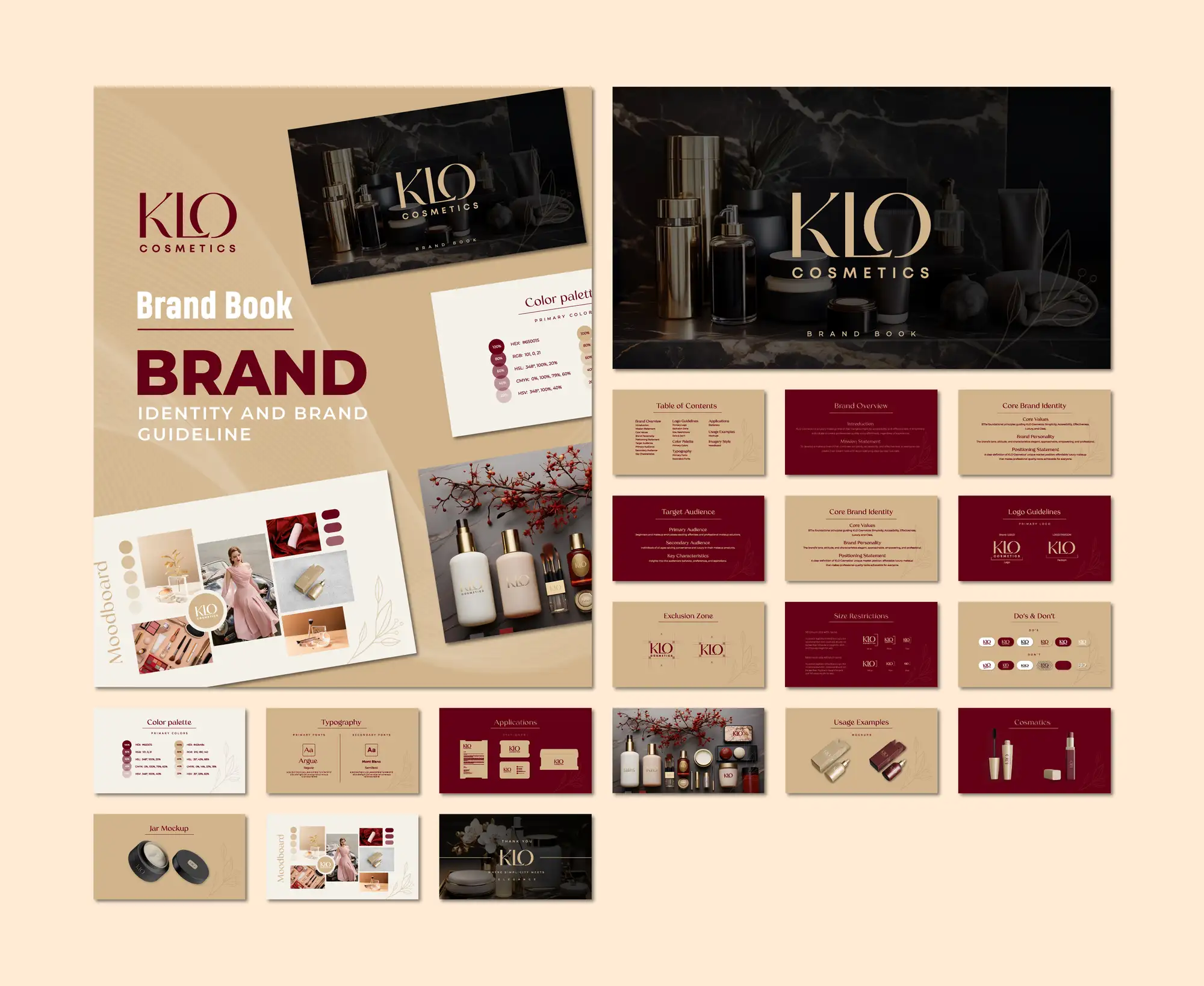
Document everything in a brand guidelines file: logo usage, spacing, colour and type specs, do's and don'ts, and real examples. This is what keeps every future designer, developer, and marketer on-brand without asking you.
Guidelines are also what makes an identity portable between projects: the same colour and type system that shapes your website should shape your pitch deck, your ad creatives, and your packaging, without each designer reinterpreting the brand from scratch.
What each step produces, and roughly how long it takes
Timelines vary by scope, but this is a realistic shape for a focused project so you can plan around it rather than guess.
| Step | What it produces | Typical time |
|---|---|---|
| 1. Strategy & positioning | Positioning statement, brand attributes | 2-4 days |
| 2. Moodboard & direction | Agreed visual direction | 2-3 days |
| 3. Logo suite | Primary, secondary, and icon logos | 1 week |
| 4. Colour & typography | Palette and type system with specs | 3-5 days |
| 5. Imagery, voice & components | Photography/icon style, voice notes | 3-5 days |
| 6. Brand guidelines | Documented guidelines file | 3-5 days |
Brand identity checklist
Use this to sanity-check that your identity is actually a system:
- Positioning statement and three brand attributes written down
- Primary, secondary, and icon logo versions that work in one colour
- Colour palette with exact values and accessible pairings
- Heading and body typefaces with a defined hierarchy
- Defined imagery and icon style
- A short voice and messaging guide
- A brand guidelines document anyone can follow
If you cannot hand your brand to a new freelancer and get on-brand work back without a call, your identity is not documented well enough yet.
Who should be involved in each step
Strategy works best with the founder or leadership team in the room, since positioning decisions need real authority behind them. The moodboard and logo stages benefit from a small review group, three or four people, not a company-wide poll, since design-by-committee tends to produce the blandest option rather than the most distinctive one. Guidelines, by contrast, should be reviewed by whoever will actually use them day to day, a marketer, a developer, a future hire, so gaps get caught before launch rather than six months in.
The most common mistake
Starting with the logo. When the logo is designed before the strategy, everything after it is decoration with no anchor, and you often end up redoing the logo anyway. Strategy first, always.
The second most common mistake is close behind: treating the identity as finished the day the guidelines are delivered, then never checking it against how the brand is actually being used a year later. Identities drift, a slightly different blue creeps into a slide deck, a freelancer substitutes a similar font, and small inconsistencies compound until the brand looks improvised again. A short annual check against the guidelines catches this before it spreads, and is far cheaper than the redesign that eventually follows if it doesn't.
Signs your identity needs a refresh, not a rebuild
Not every brand problem calls for starting over. If the strategy still holds true but the execution feels dated, inconsistent, or was never properly documented, a refresh of the logo, palette, and guidelines is usually faster and cheaper than a full rebuild. Reach for a full rebuild only when the positioning itself has changed, see when to rebrand without losing customers for how to tell the difference.
Want this built for you as one system, from strategy to guidelines? See our brand identity and guidelines service. Once your identity is set, you will want a website that matches it, and ad creatives and a pitch deck that carry the same system.
Deciding what to buy? Compare a full brand identity package for small businesses, and see how to keep it intact once AI enters your content workflow.
Frequently asked questions
How long does it take to build a brand identity?
A focused brand identity, from strategy through to guidelines, typically takes two to four weeks depending on scope and review cycles. A logo alone can be done faster, but the full system is what delivers consistency.
What is the difference between brand strategy and brand identity?
Brand strategy is the thinking: who you serve, your positioning, and the feeling you want to own. Brand identity is how that strategy is expressed visually and verbally, the logo, colours, typography, imagery, and voice.
Do I need brand guidelines as a small business?
If more than one person ever creates content with your brand on it, yes. Guidelines keep everything consistent across designers, developers, and marketers, and save money on redesigns.
Can I build a brand identity myself?
You can start the strategy yourself, and small projects can begin with a logo and a basic colour and type pairing. A full, consistent system usually benefits from a designer who builds it to scale across every touchpoint and hold up as the business grows.
Want this done for you?
FRPROTECH is a Top Rated Plus Upwork agency with 3,000+ projects delivered across 30+ countries. Tell us your goals and we'll handle the rest.
Written by the FRPROTECH design team. 8+ years building brands and websites for clients in 30+ countries, with a 100% Job Success Score on Upwork.